
Description
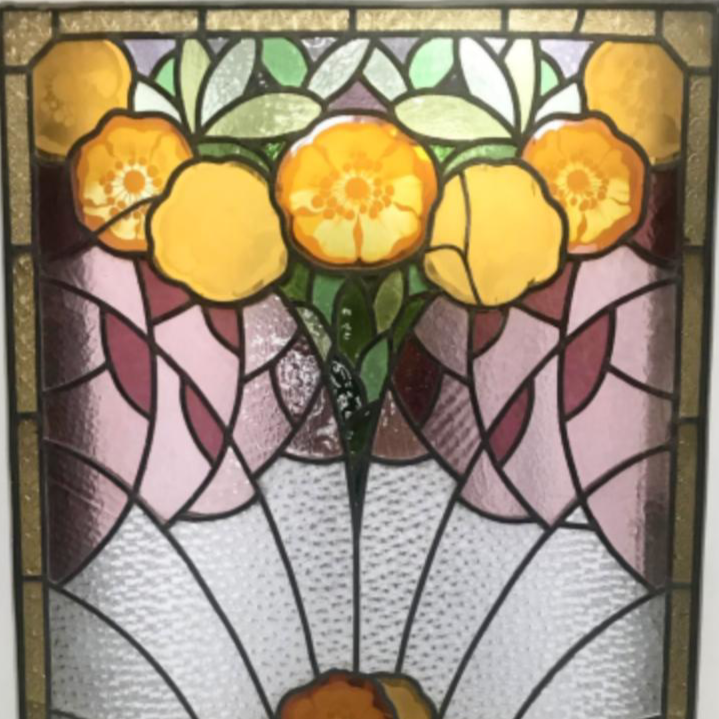
The stained glass presented in the image, with its particular use of rough glass, is an evocative sample of the audacity and inventiveness of Modernism, where texture becomes an artistic element as relevant as color and form. This piece, imbricated in the spirit of the period, demonstrates how artisans sought to explore new expressive possibilities beyond mere transparency.
The overall composition is structured around an explosion of floral and botanical motifs. At the top, a row of yellow and orange flowers, with a subtle variation of tones that gives them volume, rises towards the sky, suggesting a springtime exuberance. Their gently undulating outline, delineated by lead lines, gives them an almost tactile presence. These flowers are complemented by green foliage at the top that anchors the composition in nature. The use of rough glass in the lower central section is one of the most outstanding features of this stained glass. This type of glass, with its irregular, textured surface, not only diffuses light in a unique way, creating a veiled, ethereal effect, but also adds a visual richness that smooth glass could not offer. The lead lines in this section open in a radial pattern, like a fan or the petals of a giant flower, generating a dynamism that contrasts with the stability of the floral shapes. The color palette is vibrant and harmonious, with yellows and oranges that are replicated at the bottom, on a base of turquoise blues that suggest an aquatic element or a sky on the horizon. The pink and purple tones in the upper middle section bring warmth and a smooth chromatic transition.
This stained glass is not only a decorative piece, but a multisensory experience. The light that passes through it is fragmented and distorted, creating a constant play of brightness and shadows that transforms the surrounding space, offering an artistic vision of the world where beauty resides in both the transparency and the textured opacity of the glass.